What Is a Grease Gun Used For? A Complete Guide to Greasing Equipment
A grease gun is used to apply lubricating grease to moving mechanical parts through grease fittings. It allows you to deliver grease directly to bearings, bushings, joints, pins, and other lubrication points where friction and wear can occur.
Grease guns are commonly used on cars, trucks, trailers, tractors, lawn equipment, construction machinery, farm equipment, and industrial machines. Instead of spreading grease by hand, the gun forces lubricant through a coupler and into a fitting—often called a Zerk fitting—so the grease reaches the component that needs lubrication.
In simple terms, a grease gun helps keep moving parts lubricated, reduce friction, limit wear, protect against corrosion, and support longer component life when the correct grease and lubrication procedure are used.
What Does a Grease Gun Do?
A grease gun stores grease in a barrel or reservoir and pushes it through a hose or rigid extension when you operate the lever, handle, trigger, or motor. The coupler on the end of the gun attaches to a grease fitting on the equipment.
Once connected, pressure from the grease gun forces lubricant through the fitting and into the component. This makes it possible to lubricate areas that would otherwise be difficult to reach or impossible to grease accurately by hand.
The basic process is:
- Load the grease gun with the correct grease.
- Prime the gun and remove trapped air if necessary.
- Clean the grease fitting.
- Attach the coupler securely to the fitting.
- Pump or trigger the gun to deliver grease.
- Stop when the correct amount has been applied.
- Remove the coupler and wipe away excess grease.
Correct quantity matters. More grease is not always better. Over-greasing can be harmful in some applications, just as insufficient lubrication can increase friction and wear.
What Is a Grease Gun Used For?
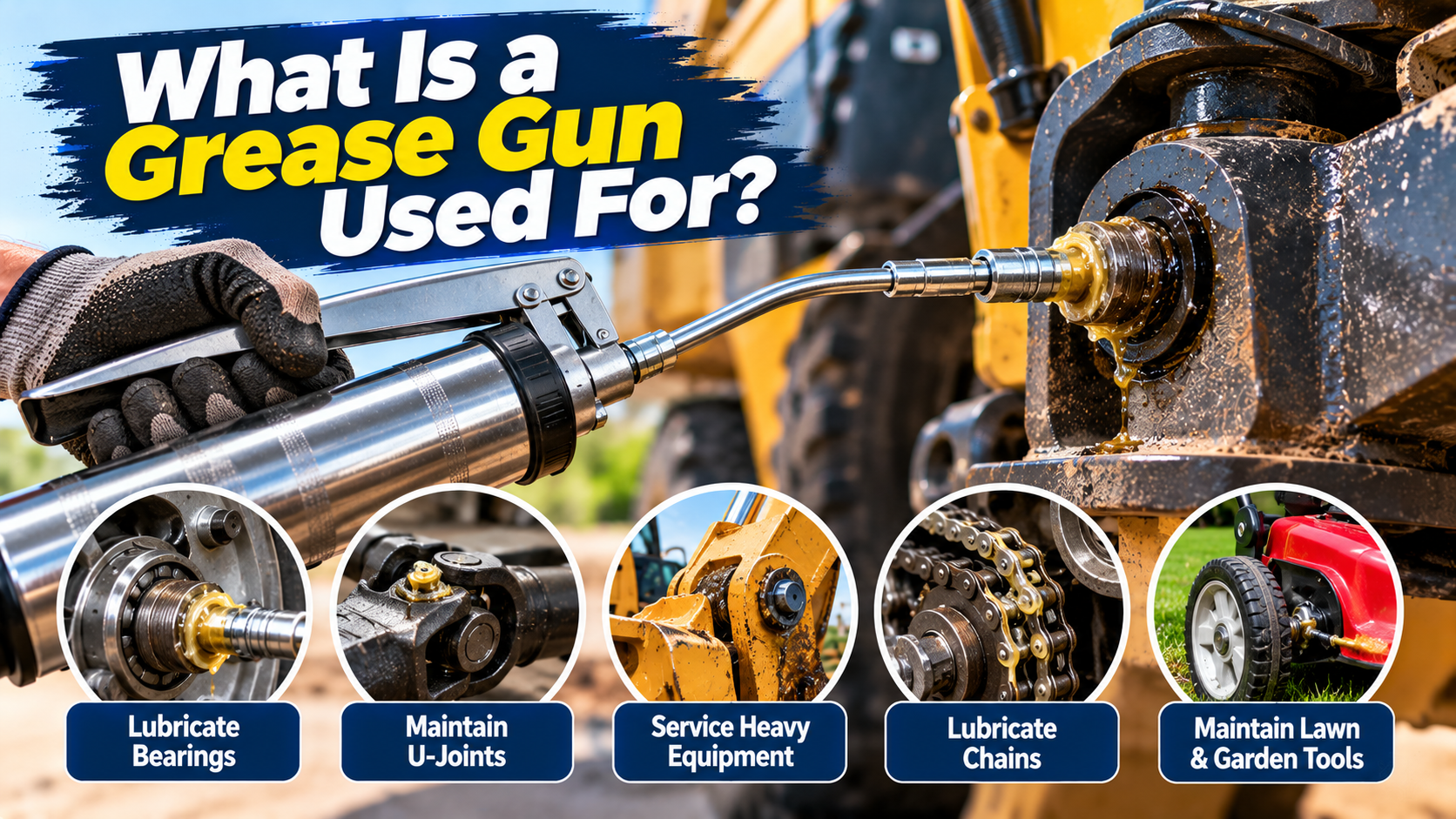
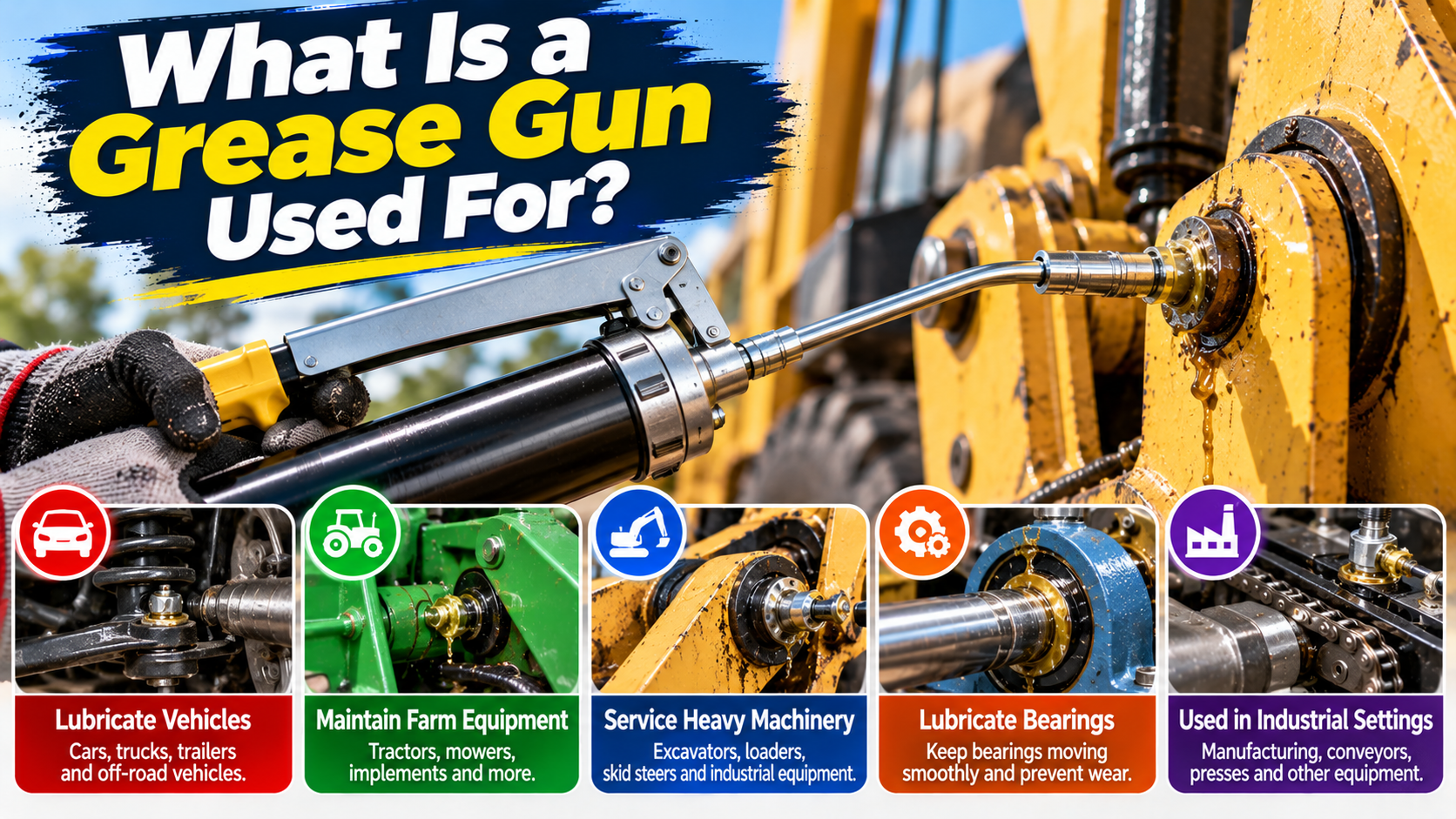
The main purpose of a grease gun is to perform manual lubrication of greaseable mechanical components. Here are some of its most common applications.
1) Lubricating Bearings
Bearings allow parts to rotate or move while minimizing friction. Many serviceable bearings require periodic greasing, particularly on heavy equipment, trailers, agricultural machinery, and industrial equipment.
A grease gun delivers lubricant through the bearing’s grease fitting, helping maintain an adequate lubricating film between moving surfaces.
However, not every bearing should be greased with a grease gun. Some bearings are sealed for life, while others require a specific lubricant and quantity. Always follow the equipment manufacturer’s lubrication instructions.
2) Greasing Chassis and Suspension Components
Some vehicles and older serviceable suspension systems have grease fittings on components such as ball joints, tie-rod ends, steering joints, and other chassis points.
A grease gun can be used during routine maintenance to replenish lubricant in these serviceable joints. Many modern passenger vehicles use sealed components without grease fittings, so you should never assume every suspension part needs manual greasing.
For related vehicle maintenance, ***how to use a grease gun on a car*** is a useful topic to understand before servicing multiple chassis lubrication points.
3) Lubricating Universal Joints and Driveline Components
Serviceable universal joints, slip yokes, and certain driveline components may include grease fittings. Proper lubrication can reduce friction and wear where the parts articulate or slide.
This is common on some trucks, off-road vehicles, agricultural equipment, and machinery. The correct grease specification and service interval depend on the manufacturer and operating conditions.
4) Maintaining Farm Equipment
Grease guns are essential maintenance tools on many farms because tractors, loaders, implements, mowers, balers, and other machines can have numerous grease points.
Pins, pivots, bushings, bearings, and joints may operate under heavy loads and in dusty, wet, or dirty conditions. Regular lubrication according to the equipment’s service schedule can help protect these components from premature wear.
5) Lubricating Construction Equipment
Excavators, skid steers, loaders, backhoes, and other construction machines often have multiple grease points around pins, bushings, pivots, and attachments.
Because these machines can experience high loads and harsh operating conditions, greasing is often an important part of routine maintenance. Battery-powered or pneumatic grease guns can be particularly useful when a machine has many fittings to service.
6) Servicing Lawn and Outdoor Power Equipment
Some riding mowers, zero-turn mowers, utility vehicles, and other outdoor equipment include grease fittings on wheel assemblies, steering components, deck spindles, pivots, or other moving parts.
Check the owner’s manual before greasing because lubrication points and service intervals vary substantially between models.
7) Lubricating Industrial Machinery
Grease guns are widely used in manufacturing and maintenance environments. Depending on the equipment, technicians may grease bearings, pivots, bushings, conveyors, hinges, and other designated lubrication points.
Industrial lubrication requires careful lubricant identification. Mixing incompatible greases or introducing dirt into a lubrication point can create problems rather than prevent them.
Common Parts That May Be Greased With a Grease Gun
Depending on the vehicle or machine, a grease gun may be used on:
- Bearings
- Bushings
- Pivot pins
- Ball joints
- Tie-rod ends
- Universal joints
- Slip joints or splines designed for greasing
- Steering components
- Trailer components
- Farm machinery joints
- Construction equipment pins and bushings
- Some mower and outdoor-equipment lubrication points
The presence of a grease fitting is usually the clearest indication that a component was designed for grease-gun lubrication. Even then, use the grease type, amount, and service interval specified by the manufacturer.
What Is a Zerk Fitting?
A Zerk fitting, also known as a grease fitting or grease nipple, is a small fitting installed on a component to provide an access point for grease.
The grease gun coupler locks or presses onto the fitting. When grease is pumped into it, an internal check mechanism allows grease to enter while helping prevent it from flowing back out.
Grease fittings are available in different sizes, thread types, angles, and styles. Straight, 45-degree, and 90-degree fittings are common because different equipment designs require different access angles.
Types of Grease Guns
Grease guns all perform the same basic job, but the way they generate pressure differs.
Manual Lever Grease Gun
A lever grease gun uses a hand-operated lever to pump grease. It is simple, durable, relatively inexpensive, and suitable for general maintenance.
The main disadvantage is that it normally requires two-handed operation, which can be inconvenient when the fitting is difficult to reach.
Pistol-Grip Grease Gun
A pistol-grip model is operated by squeezing a handle. Its biggest advantage is easier one-handed pumping, allowing the other hand to control the hose or coupler.
It is a practical choice for home garages and light-to-moderate maintenance work.
Battery-Powered Grease Gun
A cordless grease gun uses an electric motor to pump grease. It can significantly reduce effort when servicing equipment with many lubrication points.
These tools are popular with mechanics, farmers, fleet technicians, and heavy-equipment operators. If you are comparing cordless options, ***DeWalt vs Milwaukee grease gun*** is a closely related buying topic.
Pneumatic Grease Gun
A pneumatic grease gun uses compressed air to dispense lubricant. It is useful in shops and industrial environments where an air supply is already available and frequent greasing is required.
How to Use a Grease Gun Correctly
Although individual tools differ, the general process is straightforward.
Step 1: Confirm the Correct Grease
Check the owner’s manual, service manual, or lubrication chart. Greases differ in base oil, thickener, additives, consistency, temperature range, and application. Do not choose grease solely by color.
Step 2: Load and Prime the Grease Gun
Install the cartridge or fill the reservoir according to the grease gun manufacturer’s instructions. Air trapped in the gun can prevent it from pumping correctly, so the gun may need to be primed after loading.
Step 3: Clean the Grease Fitting
Wipe dirt, sand, old grease, and other contamination from the fitting before connecting the coupler. This is an easy but important step because you do not want the grease gun to push surface contamination into the component.
Step 4: Attach the Coupler
Push the coupler squarely onto the grease fitting until it is securely seated. A poor connection can cause grease to leak around the fitting rather than enter the lubrication point.
Step 5: Apply the Correct Amount of Grease
Pump slowly and monitor the component. Do not automatically keep pumping until grease pours out. The correct amount varies by application, and over-lubrication can damage seals or create excessive heat in some components.
Step 6: Disconnect the Coupler Properly
Release the coupler according to its design rather than aggressively pulling or bending the fitting. If the coupler is stuck, ***how to get a grease gun off a fitting*** is worth reviewing before applying excessive force.
Step 7: Clean the Area
Wipe away excess grease and inspect the fitting for damage or leakage. Keeping fittings clean also makes the next lubrication service easier.
Why Is Greasing Important?
Lubrication creates a protective film between moving surfaces. When the correct grease is applied correctly, it can help:
- Reduce friction: Lubricant separates moving surfaces and limits direct contact.
- Reduce wear: Less metal-to-metal contact can slow component wear.
- Protect against corrosion: Appropriate grease can help protect metal surfaces from moisture and corrosion.
- Support bearing and joint life: Proper lubrication is an important part of maintaining many serviceable components.
- Help exclude contaminants: In some applications, grease and sealing arrangements help protect components from dirt and moisture.
- Reduce maintenance problems: Correct lubrication can help prevent failures associated with inadequate lubrication.
The key word is correct. The wrong lubricant, contaminated grease, too little grease, or too much grease can all cause maintenance problems.
How Much Grease Should You Apply?
There is no universal number of grease-gun pumps that works for every fitting.
The amount depends on the component, grease gun output per stroke, bearing size, existing grease level, operating conditions, and manufacturer’s specification. One grease gun may dispense a different amount per stroke than another, so advice such as “give every fitting five pumps” is unreliable.
Whenever possible, follow the manufacturer’s lubrication quantity and interval. On equipment with many lubrication points, a lubrication chart can help prevent both missed fittings and over-greasing.
Can You Over-Grease With a Grease Gun?
Yes. Over-greasing is possible, and more lubricant does not necessarily provide more protection.
Depending on the component, excessive grease may increase resistance and heat, damage or displace seals, create leakage, or attract dirt around the lubrication point. Bearings can be particularly sensitive to incorrect grease quantity.
Do not use grease escaping from a seal as a universal signal that the component is properly filled unless the equipment manufacturer specifically calls for that procedure.
Grease Gun Safety: What You Should Know
A grease gun may look like a simple hand tool, but some models can generate several thousand psi of pressure. High-pressure grease can cause serious injection injuries.
- Never point a grease gun at yourself or another person.
- Do not place your fingers over the coupler or hose outlet while pumping.
- Inspect hoses and couplers for damage before use.
- Wear appropriate eye and hand protection.
- Do not use a damaged, cracked, or leaking high-pressure hose.
- Follow the grease gun manufacturer’s pressure limits and instructions.
- Keep the tool away from ignition sources when required by the lubricant’s safety instructions.
- If high-pressure grease is injected through the skin, seek immediate medical attention.
A tiny puncture from high-pressure fluid injection can be much more serious than it appears externally, so it should not be treated like an ordinary cut.
Common Grease Gun Mistakes
Using the Wrong Grease
Not all greases are interchangeable. Always confirm the lubricant specification before refilling the gun or servicing equipment.
Mixing Incompatible Greases
Different grease formulations may not be compatible. Mixing them can change lubricant consistency or performance. When changing grease types, follow the equipment or lubricant manufacturer’s procedure.
Greasing a Dirty Fitting
Attaching the coupler to a fitting covered with dirt can introduce contamination into the lubrication system. Clean the fitting first.
Over-Greasing
Continuing to pump simply because the gun still moves can apply too much lubricant. Use the specified quantity whenever available.
Ignoring a Blocked Fitting
If grease will not enter a fitting, do not simply keep increasing pressure. The fitting or lubrication passage may be blocked and should be inspected.
Forcing the Coupler Off
A coupler can remain tightly attached when pressure is trapped at the fitting. Excessive pulling can damage the fitting, hose, or coupler.
Who Needs a Grease Gun?
A grease gun is useful for anyone responsible for maintaining equipment with serviceable grease fittings, including:
- Automotive technicians
- DIY mechanics
- Truck and trailer owners
- Farmers
- Heavy-equipment operators
- Construction crews
- Fleet maintenance technicians
- Industrial maintenance teams
- Landscapers
- Owners of greaseable lawn and outdoor equipment
If none of your equipment has grease fittings, you may rarely need one. For machinery with dozens of lubrication points, however, a grease gun can be one of the most frequently used maintenance tools.
Frequently Asked Questions
What is the main purpose of a grease gun?
The main purpose of a grease gun is to deliver lubricating grease under pressure to a specific lubrication point, usually through a grease fitting. It is commonly used to lubricate bearings, bushings, joints, pins, and other serviceable moving components.
What is a grease gun used for on a car?
On vehicles equipped with serviceable grease fittings, a grease gun may be used to lubricate certain chassis, steering, suspension, driveline, or joint components. Many modern cars use sealed components, so check the vehicle’s service information before attempting to grease them.
Can you use any grease in a grease gun?
A grease gun can physically accept many cartridge greases of the correct cartridge size, but that does not mean every grease is suitable for your equipment. Use the lubricant specification recommended for the component.
Why won’t my grease gun pump grease?
Common causes include trapped air, loss of prime, an incorrectly installed cartridge, an empty cartridge, a blocked fitting, a damaged coupler, or a problem with the gun itself. ***How to prime a grease gun*** is an important troubleshooting topic when a newly loaded gun will not dispense grease.
How often should equipment be greased?
There is no single schedule for all equipment. Greasing intervals depend on the machine, component, workload, environment, lubricant, and manufacturer’s maintenance recommendations. Equipment working in wet, dusty, or heavy-load conditions may require different service intervals from lightly used equipment.
Is a battery grease gun better than a manual grease gun?
Neither is universally better. Manual guns are simple, inexpensive, and well suited to occasional maintenance. Battery-powered guns reduce pumping effort and are often more efficient when servicing machines with many grease points.
Conclusion
So, what is a grease gun used for? It is used to deliver grease precisely to designated lubrication points on vehicles, farm machinery, construction equipment, industrial machines, trailers, lawn equipment, and other greaseable systems.
The tool is simple, but good greasing practice requires more than attaching the coupler and pumping. You need the correct grease, correct lubrication point, correct quantity, clean fittings, and safe operating technique.
Used properly, a grease gun makes routine lubrication faster and cleaner while helping protect serviceable bearings, bushings, pins, joints, and other moving components from unnecessary friction and wear.
