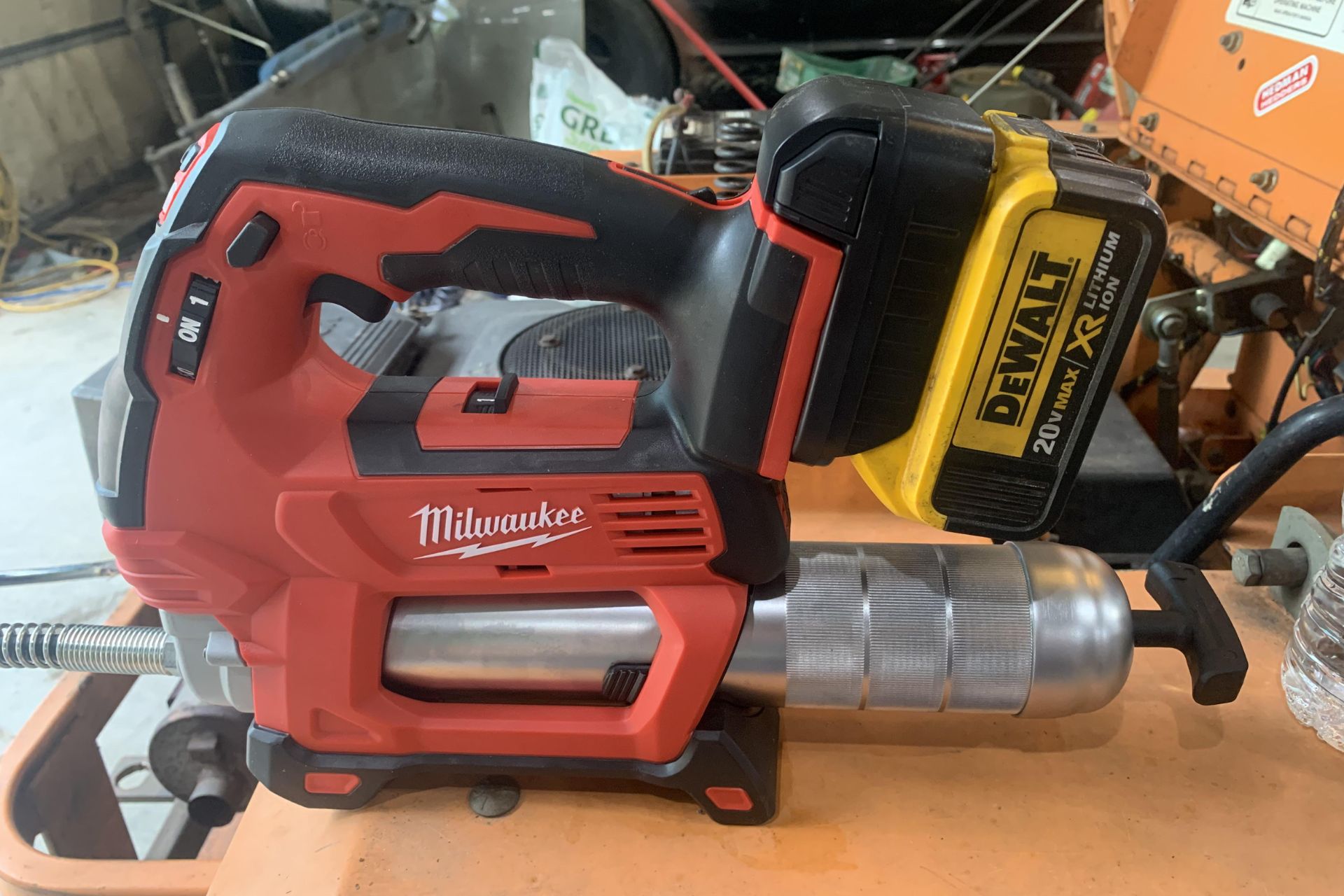
Choosing between a DeWalt vs Milwaukee Grease Gun can be surprisingly difficult. Both brands are well established in the professional cordless-tool market, and both offer powerful battery-operated grease guns designed to make routine lubrication faster, cleaner, and less tiring than using a traditional manual gun.
For mechanics, farmers, equipment owners, fleet technicians, and contractors, a cordless Grease Gun can become one of the most frequently used maintenance tools in the workshop. Instead of repeatedly pumping a lever by hand, you can connect the coupler to a grease fitting, pull the trigger, and deliver lubricant with consistent pressure.
DeWalt and Milwaukee take slightly different approaches to this job. DeWalt’s popular DCGG571 emphasizes a straightforward design, variable-speed control, high pressure, and a long flexible hose. Milwaukee’s M18 2646-20 adds two operating speeds and a preset grease counter while offering a higher maximum flow rate.
So which one makes more sense for your toolbox?
This detailed DeWalt vs Milwaukee grease gun comparison examines pressure, grease delivery, hose reach, controls, battery platforms, ergonomics, maintenance, and real-world applications to help you understand the differences.
DeWalt vs Milwaukee Grease Gun: Quick Overview
The first thing to understand is that these tools are more similar in basic capability than their different designs might suggest.
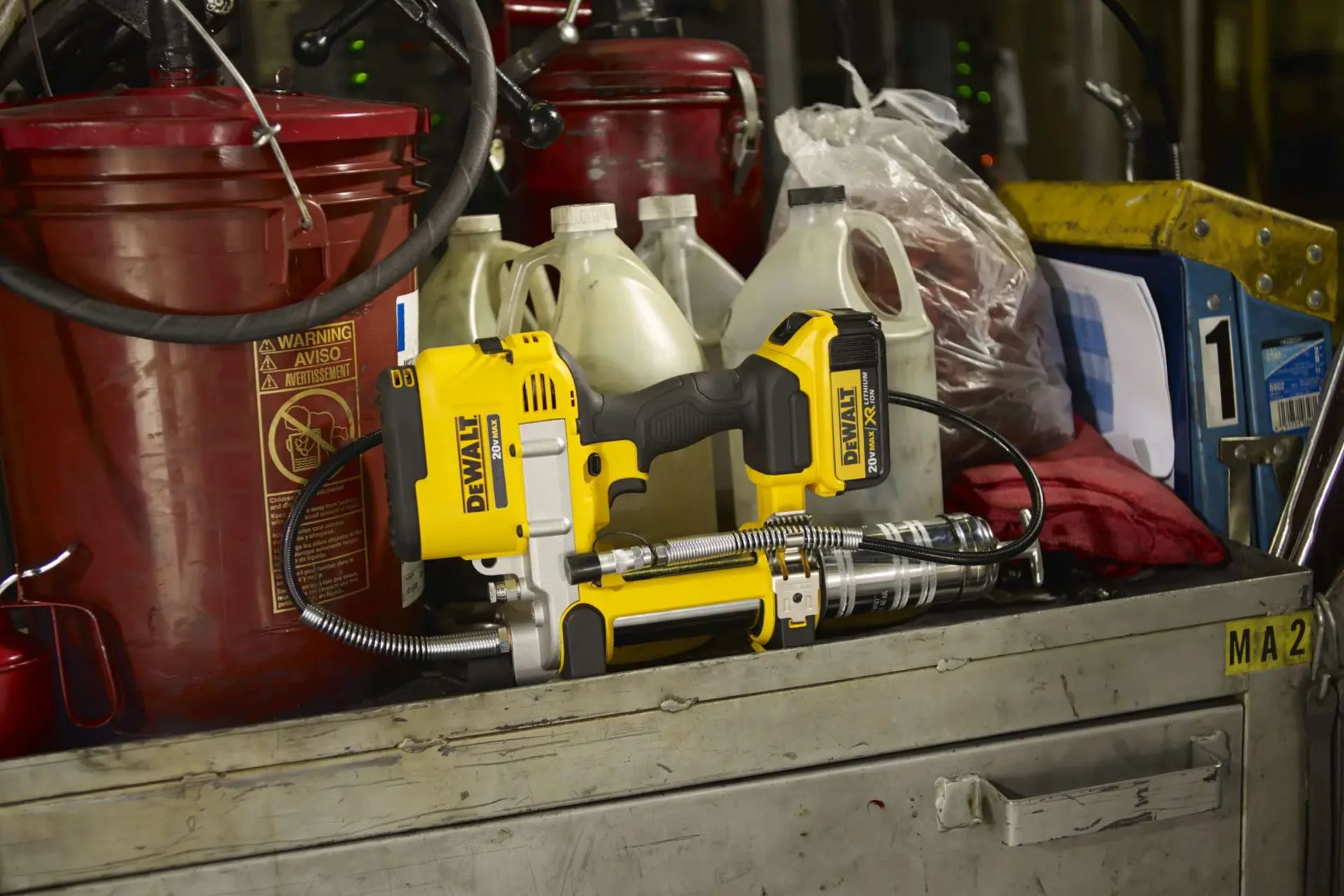
The DeWalt DCGG571 is part of the company’s 20V MAX battery platform. It produces up to 10,000 PSI and delivers grease at up to 5 oz. per minute. A variable-speed trigger allows the operator to adjust grease flow while working.
Milwaukee’s M18 2646-20 is also rated for a maximum operating pressure of 10,000 PSI. However, its two-speed system changes the balance between pressure and grease delivery. Milwaukee specifies up to 10 oz. per minute at its maximum-flow setting.
Both are intended for demanding lubrication jobs involving vehicles, agricultural machinery, construction equipment, trailers, shop equipment, and other machines equipped with grease fittings.
Key Specification Comparison
| Feature | DeWalt DCGG571 | Milwaukee M18 2646-20 |
|---|---|---|
| Battery Platform | 20V MAX | M18 |
| Maximum Pressure | 10,000 PSI | 10,000 PSI |
| Maximum Flow Rate | Up to 5 oz./min | Up to 10 oz./min |
| Speed Control | Variable-speed trigger | 2-speed system |
| Flexible Hose | 42 inches | 48 inches |
| LED Work Light | Yes | Yes |
| Air Bleeder Valve | Yes | Yes |
| Bulk Capacity | 16 oz. | 16 oz. |
| Cartridge Capacity | 14.5 oz. | 14.5 oz. |
| Grease Counter | No dedicated preset counter | Yes |
| Cordless | Yes | Yes |
The specifications reveal an important point: maximum PSI alone should not determine which grease gun you choose. Flow control, hose reach, battery compatibility, and the type of equipment you service can be equally important.
Why Use a Cordless Grease Gun?
Manual grease guns are inexpensive and useful for occasional maintenance. Their biggest limitation becomes obvious when many fittings need to be serviced.
Imagine greasing a tractor, excavator, skid steer, loader, commercial mower, or an entire fleet of vehicles. Repeatedly pumping a manual lever can become tiring and time-consuming.
A battery-powered Grease Gun reduces much of that repetitive work.
Once the coupler is properly attached to the fitting, the electric motor creates the pumping action. This can improve productivity when dozens of lubrication points need attention.
Cordless models are particularly attractive for professionals who already own compatible batteries. A mechanic with several DeWalt 20V MAX batteries, for example, may only need to purchase a bare grease gun rather than another battery and charger.
The same logic applies to Milwaukee M18 users.
DeWalt 20V MAX Grease Gun Overview
The DeWalt DCGG571 is one of the brand’s established cordless lubrication tools.
Its motor delivers up to 10,000 PSI, giving the tool enough pressure to deal with demanding fittings and many situations where grease does not flow easily.
The high-volume pump delivers up to 5 oz. of grease per minute.
DeWalt also equips the tool with a 42-inch flexible hose. That length is useful when lubrication points are positioned behind panels, underneath machinery, or around components that make direct access difficult.
Another useful feature is the variable-speed trigger.
Instead of operating at only one delivery rate, the operator can use trigger pressure to control grease flow. This is particularly helpful when moving between fittings that require different quantities of lubricant.
An LED illuminates darker work areas, while the pump filter screen helps prevent contamination from reaching the pump mechanism.
The tool also includes an air-bleeder valve to assist with priming after installing a new grease cartridge.
Milwaukee M18 Grease Gun Overview
Milwaukee approaches the same job with its M18 2646-20 two-speed grease gun.
Like the DeWalt, the Milwaukee reaches a maximum operating pressure of 10,000 PSI.
The major difference is its two-speed configuration.
One setting prioritizes pressure, while another emphasizes flow. According to Milwaukee’s specifications, the tool can deliver up to 10 oz. of grease per minute.
That higher maximum delivery rate can be valuable when working with equipment containing large lubrication points or when performing high-volume maintenance.
Milwaukee also provides a 48-inch flexible hose, giving the operator six additional inches of reach compared with the DeWalt DCGG571.
One of the Milwaukee’s most distinctive features is its preset grease counter dial. This system is intended to help maintenance professionals dispense controlled quantities of grease rather than relying entirely on timing or feel.
Other features include an LED work light, lock-on/lock-off trigger, air bleeder valve, shoulder-strap capability, and markings on the plunger rod that help indicate how much grease remains.
Grease Gun Pressure: DeWalt vs Milwaukee
Pressure is often one of the first specifications buyers examine.
Both models can reach 10,000 PSI, so neither has a major headline advantage when maximum pressure is considered alone.
High pressure becomes useful when dealing with stubborn grease fittings or resistance within the lubrication path.
However, more pressure should not automatically be considered better for every application.
Grease needs to reach the intended lubrication point without damaging components, seals, or fittings. Proper lubrication technique remains important regardless of how powerful the grease gun is.
For most users comparing these two models, pressure is therefore unlikely to be the deciding factor.
Both provide substantial pressure capability.
Flow Rate: Where the Difference Becomes Clearer
Flow rate creates a more noticeable distinction.
The DeWalt DCGG571 delivers up to approximately 5 oz. per minute.
The Milwaukee M18 2646-20 can deliver up to 10 oz. per minute in its high-flow mode.
For a user greasing only a handful of fittings, this difference may not dramatically change the overall maintenance experience.
For someone servicing heavy equipment throughout the day, however, faster grease delivery can reduce the amount of time spent at high-volume lubrication points.
There is an important tradeoff.
Maximum flow is not always desirable.
Small fittings may require only a limited quantity of grease. Pumping too quickly can make precise lubrication more difficult and potentially encourage over-greasing.
This is why control matters as much as raw output.
DeWalt approaches the problem with its variable-speed trigger, while Milwaukee provides separate operating modes and its grease counter system.
Hose Length and Accessibility
A grease gun can have impressive specifications but still be frustrating if its hose cannot comfortably reach the fitting.
DeWalt equips the DCGG571 with a 42-inch flexible hose.
Milwaukee provides a 48-inch flexible hose.
Six inches may sound insignificant on paper, but extra reach can be useful around large machinery.
Consider a grease fitting positioned behind a hydraulic line, suspension component, frame section, or protective panel. A longer hose may allow you to leave the main body of the tool in a comfortable position while guiding only the coupler toward the fitting.
For tractors, loaders, construction machinery, and agricultural equipment, hose flexibility and reach deserve serious consideration.
Control and Precision
Lubricating machinery is not simply a matter of pumping as much grease as possible.
Some components need only a small amount. Others require considerably more.
DeWalt’s variable-speed trigger provides intuitive control. Pulling the trigger differently allows the operator to influence delivery.
This design may feel familiar to users accustomed to variable-speed drills and other cordless tools.
Milwaukee takes a different approach by combining two speeds with its preset grease counter.
The counter is particularly interesting for repetitive maintenance procedures where technicians want more consistent grease delivery between similar fittings.
For example, a fleet maintenance technician servicing the same equipment repeatedly may appreciate a system that makes grease quantity easier to standardize.
Battery Platform Comparison
Battery compatibility can easily become more important than minor differences in specifications.
DeWalt’s grease gun operates on the company’s 20V MAX platform.
Milwaukee’s model belongs to the M18 system.
If you already have several compatible batteries and chargers from one manufacturer, staying within that ecosystem can simplify ownership.
You avoid purchasing additional chargers and batteries, while batteries can be shared between compatible tools.
For a workshop containing mostly DeWalt tools, adding a DeWalt Grease Gun is therefore a logical option.
A shop heavily invested in Milwaukee M18 tools receives the same benefit by selecting Milwaukee.
For buyers starting without either battery system, the decision should consider future tools as well as the grease gun itself.
Think about drills, impact wrenches, grinders, saws, lights, blowers, and other cordless equipment you may purchase later.
The battery platform can become a long-term investment.
Cartridge and Bulk Grease Capacity
Both models support common grease-loading methods.
The DeWalt DCGG571 technical information specifies a 16 oz. bulk capacity and compatibility with 14.5 oz. cartridges.
Milwaukee specifies the same 16 oz. bulk capacity and 14.5 oz. cartridge format.
Cartridges are convenient because they reduce direct contact with grease and generally make loading cleaner.
Bulk filling may make sense in workshops that purchase grease in larger quantities.
Regardless of the method, cleanliness is essential.
Contamination entering a grease gun can eventually be transferred directly into bearings, joints, and other lubricated components. Wipe dirt away from the barrel and fittings before loading or connecting the gun.
Priming and Cartridge Changes
Anyone who regularly uses a grease gun eventually encounters priming issues.
Air trapped in the system can prevent the gun from pumping properly even when the cartridge is full.
Both DeWalt and Milwaukee include an air bleeder valve designed to simplify priming.
After replacing a cartridge, the operator can use the appropriate priming procedure to remove trapped air and restore grease flow.
This might sound like a small feature, but it can save considerable frustration in a busy workshop.
If a cordless grease gun suddenly stops delivering lubricant after a cartridge replacement, trapped air should be one of the first things checked.
Visibility in Dark Work Areas
Grease fittings have a habit of being located in inconvenient places.
They may sit beneath vehicles, behind suspension parts, around agricultural machinery, or deep inside equipment where workshop lighting does not reach.
Both manufacturers address this issue with integrated LED lighting.
The light helps the operator locate the fitting and align the coupler.
A built-in LED will not replace a dedicated inspection light in every situation, but it is a practical feature when moving rapidly from one lubrication point to another.
DeWalt vs Milwaukee Grease Gun for Automotive Work
For automotive maintenance, both models provide more than enough pressure for typical lubrication work.
The DeWalt’s variable-speed trigger can be attractive when precise control is a priority.
Its 42-inch hose is also long enough for many vehicle maintenance situations.
Milwaukee provides additional hose reach and faster maximum grease delivery. The grease counter may also appeal to professional technicians performing repetitive lubrication procedures.
For occasional automotive use, however, maximum flow rate may be less important than battery compatibility, handling, and overall convenience.
Which Grease Gun Is Better for Heavy Equipment?
Heavy machinery changes the priorities.
Construction and agricultural equipment can contain numerous grease fittings, and some components consume substantially more grease than typical automotive lubrication points.
In these situations, Milwaukee’s higher maximum flow rate may be particularly useful.
The 48-inch hose can also make it easier to reach fittings around large equipment.
DeWalt remains highly capable, especially when the user prefers variable trigger control or already operates within the DeWalt 20V MAX ecosystem.
Both models reach 10,000 PSI, making them suitable for many demanding maintenance jobs.
Which One Is Better for Farmers?
Farm equipment often requires frequent lubrication.
Tractors, loaders, combines, balers, mowers, and other agricultural machines can contain many grease fittings. Maintenance sessions may therefore involve considerably more grease than servicing a passenger vehicle.
A cordless grease gun can significantly reduce repetitive hand pumping.
Milwaukee’s high-flow capability may benefit users maintaining large machines with numerous lubrication points.
DeWalt’s variable-speed control can be attractive when moving between fittings that require different amounts of grease.
Battery ownership should again influence the decision. A farm already using numerous cordless tools from one ecosystem may gain more practical value by remaining with that battery platform.
Ergonomics and Long Maintenance Sessions
Grease gun specifications rarely tell the entire story.
Handling becomes important when the tool is carried around a vehicle or piece of equipment for an extended period.
A cordless grease gun contains a motor, grease barrel, hose, and battery, making it substantially different from a small hand-operated gun.
Both DeWalt and Milwaukee support shoulder straps, which can reduce the burden of carrying the tool while moving between lubrication points.
Milwaukee also emphasizes its stand-up design, allowing the tool to remain upright when placed down.
DeWalt incorporates a no-mar foot that allows the tool to rest on flat surfaces.
These design details become more valuable during long maintenance sessions than they may initially appear.
Maintenance Tips for Any Cordless Grease Gun
Buying a quality tool does not eliminate the need for proper maintenance.
Keep the coupler clean before connecting it to a fitting. Dirt attached to the coupler can be pushed into the component along with fresh grease.
Store cartridges in a clean environment and avoid exposing open grease to dust or debris.
Inspect the flexible hose periodically for damage, especially if the gun regularly operates near sharp metal surfaces.
Clean excess grease from the tool after use.
When grease stops flowing, do not immediately assume the motor or pump has failed. Check cartridge level, trapped air, coupler condition, fitting blockage, and battery charge first.
Proper care can extend the useful life of both the grease gun and the equipment being lubricated.
Common Mistakes When Using a Grease Gun
One of the most common mistakes is assuming that more grease is always better.
Over-greasing can create its own problems. Follow the equipment manufacturer’s lubrication recommendations whenever possible.
Another mistake is connecting a dirty coupler directly to a grease fitting.
Clean both surfaces first.
Operators should also avoid excessive force on the flexible hose. Although these hoses are designed for demanding environments, repeated sharp bends or physical damage can eventually create leaks.
Finally, use the correct grease.
Different machines and components may specify different lubricant formulations. Never assume that one cartridge is appropriate for every machine in your shop.
DeWalt vs Milwaukee: Important Differences to Consider
The comparison can be reduced to several practical distinctions.
DeWalt DCGG571 offers:
- Up to 10,000 PSI
- Up to 5 oz./min grease delivery
- 42-inch flexible hose
- Variable-speed trigger
- LED work light
- Pump filter screen
- Air bleeder valve
- Compatibility with DeWalt 20V MAX batteries
Milwaukee M18 2646-20 offers:
- Up to 10,000 PSI
- Up to 10 oz./min maximum flow
- 48-inch flexible hose
- Two operating speeds
- Preset grease counter
- LED work light
- Lock-on/lock-off trigger
- Air bleeder valve
- Compatibility with Milwaukee M18 batteries
Neither specification sheet tells every buyer which tool is automatically right.
The best fit depends heavily on workload and battery ownership.
Who Should Choose the DeWalt Grease Gun?
The DeWalt DCGG571 makes particular sense for users already invested in DeWalt 20V MAX batteries.
Its variable-speed trigger provides straightforward control without requiring a complicated operating process.
It is also a strong match for automotive technicians, DIY mechanics, equipment owners, and farmers who want substantial pressure but do not necessarily need extremely high grease delivery.
The 42-inch hose provides useful reach, while the filter screen and air bleeder add practical protection and convenience.
Users who prefer controlling flow directly through trigger pressure may especially appreciate the DeWalt design.
Who Should Choose the Milwaukee Grease Gun?
The Milwaukee M18 2646-20 deserves consideration when high-volume lubrication is a major priority.
Its maximum flow rate is particularly attractive for technicians working on construction machinery, agricultural equipment, fleets, and other machines containing many grease points.
The 48-inch hose offers additional reach.
The preset grease counter also separates Milwaukee from many simpler cordless grease guns. Users performing standardized maintenance may find this feature valuable when trying to deliver repeatable quantities.
And, naturally, existing M18 battery owners gain the convenience of staying within their current cordless ecosystem.
What Should You Look for Before Buying a Grease Gun?
Do not choose solely by brand name.
Start with the equipment you actually maintain.
A home mechanic servicing a few vehicles has very different requirements from a technician lubricating excavators throughout the day.
Consider:
- Required operating pressure
- Grease delivery rate
- Hose length
- Flow control
- Battery compatibility
- Cartridge capacity
- Tool weight
- Ease of priming
- LED lighting
- Grease quantity control
- Availability of replacement hoses and couplers
Battery ownership deserves extra emphasis.
If you already have multiple batteries from either manufacturer, changing platforms solely for a grease gun may increase the total cost substantially.
Is a Cordless Grease Gun Worth Buying?
For frequent lubrication work, it often can be.
The biggest advantage is productivity.
A manual grease gun is perfectly capable of lubricating machinery, but repeated pumping becomes inefficient when dozens of fittings are involved.
Battery-powered models allow the motor to perform that repetitive work.
This can be especially valuable for farms, construction businesses, repair shops, trucking operations, industrial facilities, and equipment fleets.
For someone greasing one or two fittings several times per year, a manual grease gun may still be perfectly adequate.
The more frequently you lubricate equipment, the easier it becomes to justify a cordless model.
Frequently Asked Questions
Is Milwaukee More Powerful Than DeWalt?
Both the Milwaukee M18 2646-20 and DeWalt DCGG571 are rated for maximum pressure of 10,000 PSI. Milwaukee, however, offers a higher stated maximum flow rate.
How Fast Does the DeWalt Grease Gun Pump?
The DeWalt DCGG571 is rated to deliver grease at up to 5 oz. per minute.
How Fast Does the Milwaukee Grease Gun Pump?
Milwaukee specifies a maximum flow rate of up to 10 oz. per minute for the M18 2646-20.
Which Grease Gun Has the Longer Hose?
The Milwaukee M18 2646-20 uses a 48-inch flexible hose, while the DeWalt DCGG571 uses a 42-inch hose.
Do Both Grease Guns Reach 10,000 PSI?
Yes. Both models are specified for maximum pressure of 10,000 PSI.
Can They Use Standard Grease Cartridges?
Both support 14.5 oz. grease cartridges and can also accommodate 16 oz. of bulk grease.
Does Battery Brand Matter?
Yes. DeWalt uses its 20V MAX battery platform, while Milwaukee uses the M18 system. Existing battery ownership can significantly affect the total cost and convenience of either option.
Conclusion
The DeWalt vs Milwaukee Grease Gun comparison is closer than it first appears because both tools provide professional-level pressure, cordless convenience, long flexible hoses, LED lighting, and practical priming features.
The DeWalt DCGG571 stands out for its simple variable-speed control, 10,000 PSI maximum pressure, 42-inch hose, and compatibility with the extensive 20V MAX platform. It is a practical option for mechanics, farmers, contractors, and equipment owners who value controlled grease delivery.
The Milwaukee M18 2646-20 takes a more feature-focused approach. It combines 10,000 PSI maximum pressure with a two-speed system, up to 10 oz. per minute maximum flow, a 48-inch hose, and a preset grease counter. Those characteristics can be particularly useful for high-volume or repetitive equipment maintenance.
Ultimately, your existing battery system, lubrication workload, desired flow rate, and need for precise grease control should guide the decision. Either Grease Gun can dramatically reduce the effort required to keep vehicles and machinery properly lubricated compared with traditional manual pumping.
